Benefits of Urban Trees, A Plea for Trees

Imagine, if you will, walking through a busy city street filled with the sound of traffic, rushing pedestrians, and the hum of a city. Now, picture that same street in a different light with tall, mature trees lining the street and providing shade, with leafy branches overhead filtering out sunlight and noise, instantly making the city feel more peaceful, welcoming, and lively.

Mature urban trees are not just nice to look at, they are powerful allies in creating healthier, more sustainable cities. Their virtues extend beyond aesthetics, offering valuable ecosystem services, increasing municipal worth, and improving our day-to-day experiences.

Ecosystem Champions

Mature trees in cities are ecosystem heroes. These living monuments purify the air, sucking up harmful particulates and absorbing greenhouse gases, especially carbon dioxide. In fact, one mature tree can absorb up to 48 pounds of CO2 a year, helping cities combat the effects of climate change while producing the oxygen we need to live.

Trees also act as natural stormwater managers. Their deep root systems process massive amounts of rainwater, minimizing runoff and helping prevent flooding. They absorb pollutants, shielding local waterways, improving water quality, and protecting wildlife.

Financial and Distributed Value

Mature urban trees can be valued in monetary terms. Cities with lush tree canopies have lower energy costs because trees offer natural air conditioning: they shade buildings in the summer and serve as windbreaks in the winter. The U.S. Department of Agriculture estimates that if planted just right, mature trees can reduce air-conditioning costs by as much as 30 percent and heating costs by 20 to 50 percent.

In addition, urban trees significantly raise property values. Properties located in neighborhoods with mature, well-maintained trees see property values increase by as much as 20%, as green space attracts new tenants and promotes a high quality of life. Cities also save money on infrastructure repair, since tree-lined streets mitigate the solar heating of pavement, extending its usable life and saving taxes.

Benefits for Aesthetics and Culture

Apart from quantifiable environmental and financial benefits, mature trees offer irreplaceable aesthetic and cultural worth. Their grand beauty becomes a neighborhood identifier that promotes community pride and connection. Mature trees along streets beckon pedestrians, inspire people to walk and be outside, unite neighbors, and develop flourishing communities.

Sadly, mature trees often lost to development pressures or disease play a vital role. Restoring these priceless natural resources will take no small amount of time or ease. Regrowing a tree to its full stature which can take decades and sometimes more than half a century under today’s climate conditions will fail to reproduce the ecosystem services that an adult tree is already providing.

Building on Better Coping Skills

Maybe the most personal and higher impact of mature urban trees is on our emotional and mental well-being. Studies show that urban trees lower stress, enhance mood, and boost feelings of relaxation and happiness. Those who live near green spaces report greater satisfaction with their surroundings, stronger social bonds, and a greater sense of well-being. Even gazing at trees through a window can expedite recovery from illness, lower blood pressure, and decrease anxiety.

Consider the silent comfort of taking sanctuary below a tree’s shade on a hot summer day, the comforting sound of leaves rustling together in the breeze, and the child’s delight in climbing branches or watching birds build nests high above. These daily relationships with trees reaffirm our fundamental ties to nature and one another.

Our older urban trees are more than elements of the landscape they are essential members of our communities. They improve our quality of life, safeguard our environment, and promote our mental health. Protecting and caring for these natural wonders strengthens the urban landscape for a healthier, happier future for you and your descendants.

EPA’s Purpose Radically Changed

EPA’s Purpose Radically Changed

Since the Trump administration took over in January, keeping up with and reporting on all of the geopolitical, economic and legal ramifications has been beyond my capabilities.  But I am going to try to keep an eye on the environmental aspects of the changes.  As an environmentalist, they are frightening to me. I remember the many environmental problems before the EPA was created.

Trumps EPA Administrator Lee Zeldin was sworn in on January 29th,  and has been trying to reframe the purpose of the agency towards deregulation of environmental and energy production and away from environmental  and  public health protection—saying on X that the agency’s mission is to “lower the cost of buying a car, heating a home, and running a business.”.  He announced plans to repeal dozens of major environmental regulations, including protections protection of wetlands, limits on tail pipe and smokestack pollution, and the endangerment finding—the legal basis for regulation of greenhouse gases now heating the planet.

None of these announcements carry the force of law, and the efforts will have to undergo a lengthy process of public comment and show environmental and economic justifications to the change.  Environmentalists are understandably upset about turning the EPA away from its original purpose of protecting of the health of people and the environment.  They say that Zeldin lied during his confirmation hearings when he said he would respect science and listen to the experts, who agree that climate change is real.  The experts also say that climate change is responsible for the hottest temperatures in recorded history going back centuries and that it is responsible for 27 disasters in 2024 that cost at least $1billion each, compared to three in 1980.  `

Additionally, the EPA announced that when they create environmental policy, they will no longer consider costs to society from wildfires, droughts, storms and other disaster that could be made worse by pollution connected to that policy.

The EPA also recently announced that they will stop all its Environmental Justice programs, saying that they are part of Biden’s DEI programming and take away from funds used to directly remediate environmental issues in communities. The goal has been to give aid to underserved communities and communities of color that have been disproportionately harmed by toxic pollutants from factories and refineries in their communities. Environmental Justice staff have all been put on administrative leave and their 11 offices throughout the US are closed.  Hundreds of grants have also been cancelled by the EPA, many of which were environmental justice grants.

I am sure that these actions will lead to many complaints and lawsuits, as have so many of the Trump administration actions—124 lawsuits filed as of March 11, including 2 closed cases.  The Supreme Court has begun to weigh in, siding once with the Administration and twice against it. Some of the Administration’s actions have been partially blocked or overturned, at least temporarily.  Stay tuned…and let you congressional and senate representative know how you feel. Join KEC and other local organizations to strategize how we can make a difference by our own actions.

Source:  The New York Times—March 11,12 & 14,  2025)

Event Alert: Spring Into Heath — Saturday, March 22 (Randolph)

Spring Into Health

Saturday, March 22, 11am to 5pm
At the Randolph Community Center
1639 Rt 44, Randolph, Ohio

Free to the Public

Program

  • 11 am, Nature and Healing, Jennifer White of Portage Parks
  • 12 pm, Pruning Apple Trees, David Stotler
  • 1 pm, Spinal Health, Sonya Barker, Melanie Mills-Juhasz
  • 2 pm, All about Herbs, Ruth Davis

KEYNOTE PRESENTER:

KLAAS MARTENS
3-5 pm, “What the weeds are telling us”

Klaas has been farming 1,600 acres in New York for
over 50 years.

Healthy food will be available for purchase thanks to:
RAMBLING ROSE KITCHENETTE

This event is sponsored by Sarchione Chevrolet and
Randolph Massage and Wellness Center

2025 Annual Meeting and Speakers

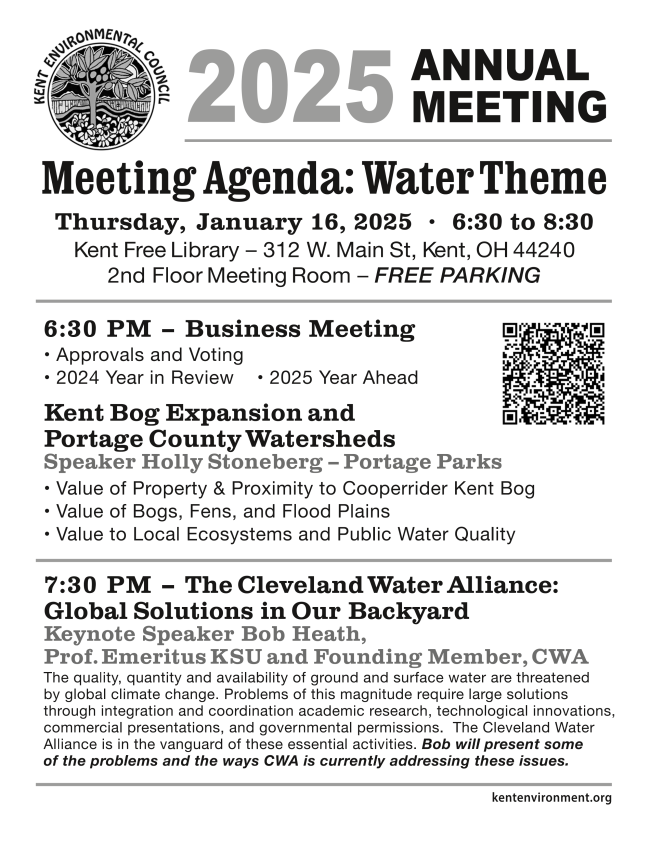
KEC hopes you will attend to participate in KEC and learn about our local water environment. After the short business meeting, there will be a brief talk by Holly Stoneberg about the Kent Bog Expansion and then the keynote speaker will be Dr. Robert Heath, who will talk about the Cleveland Water Alliance’s vision and efforts for Global Solutions in Our Backyard. This meeting is open to the public.

Date: Thursday, January 16, 2025 from 6:30 to 8:30
Place: Kent Free Library, 312 W. Main St., Kent, OH 44240
Second Floor Meeting Room –Free Parking

Please see the flyer below for agenda and presentation details.  To get a printable copy of the flyer, click here. Feel free to post or send to others you think may be interested.

KEC Board: Todd Cartner, President; Bob Heath, Vice President; Brad Brotje, Secretary; Bob Wilson, Treasurer; Lorraine McCarty; Renee Ruchotzke; Mary Starbuck, At-Large Members

EVENT ALERT: Bioregional Network Weaving with Kelly Clark

Are you feeling despair about climate change and its impact on the land? Are you frustrated that those in power are looking to accelerate extraction and exploitation, harming our earth, water, and air? Are you looking for a community who perceives the losses and damage, and wants to find a new way forward grounded in local empowerment and action?

Come hear a vision for Northeast Ohio as a Bioregion, a geographical area defined not by political boundaries but by ecological systems. There are already numerous regenerative farms, skill-shares, homesteaders, permaculturists, community gardeners, alternative energy enthusiasts, holistic heath practitioners, skill sharers, natural builders (e.g. straw bale and cob), and artists that have a common understanding, and Kelly Clark (of Kelly’s Working Well Farm) has a vision for weaving connection and collaboration. Anyone who is looking for people, projects, or communities to connect to and collaborate with are encouraged to attend, especially if you are already doing something!

Connect. Communicate. Cooperate. Collaborate!

Bioregioning in NEO: Let’s make it Happen!

Thurs Jan 30, 6 – 8pm Unitarian Universalist Church, 228 Gougler Ave, Kent 44240

Free Event —- Directions and Parking —- Event is in Church Sanctuary (2nd floor). Accessible entrance in front.

Join the network at glessbioregion.net

THE GOOD NEWS

One recent local item and a sampling of 2024 victories by several environmental organizations—some at the federal level but most at the state/local level, which experts say is a hopeful pathway during the incoming Trump administration.  Read about victories at the Ohio Environmental Council, Earthjustice, NRDC, and Sierra Club.

LOCAL

New access point to open in Peninsula for canoes and kayaks.  In May, this new access at Northampton Point will open off Akron off Akron Peninsula Road.  It will include a parking lot, a seating area, and a small changing room structure and a portable restroom. Summit MetroParks and Cuyahoga Valley National Park collaborated on this project.  This is in addition to the recently opened river access site at the Valley View Area of Cascades Valley Metro Park which is only a 6-mile paddle, which would take about 2 to 3 hours to complete—a reasonable trip.  Source:  Akron Beacon Journal–December 5, 2024

OHIO ENVIRONMENTAL COUNCIL (OEC)—From OEC’s 2024 Annual Report

  • The OEC commissioned a critical analysis of the economic and health benefits of replacing lead water service lines.  Th cost-benefit analysis found it would result in a return of $32 to $45 for every dollar invested, a return between $145 billion and $185 billion over the next 15 years, as well as better physical and mental health outcomes for Ohio families. The updated federal Lead and Copper Rule Improvements mandates that most US service water systems replace 100% of lead service lines in the next 10 years, supported by funding from the bipartisan Infrastructure Law.  The OEC and the OEC Action Fund, as well as partners at the Alliance of the Great Lakes, helped draft Ohio House Bill 354 years ago, which supports this effort, and they will advocate for its adoption at the Statehouse.
  • The OEC provided expert testimony, highlighting the Oak Run Solar Project, which was approved by the Ohio Power Siting Board in 2024. They noted this project’s potential to mitigate climate change and its design to reduce harmful stormwater runoff, as well as the estimation that it will create about 1,500 construction jobs and contribute $8.2 million annually to local governments and schools.  This project is an example of Ohio’s transition toward renewable energy while ensuring the integration of sustainable agricultural practices.  The OEC also supported a bill that narrowly passed to allow utility companies to restore energy restore energy efficiency measures that were rolled back by Ohio’s controversial HB6 in 2019.  The OEC Action Fund will continue to push for the Senate to pass this legislation too.
  • The OEC is actively opposing the leasing for fracking in 40,000 acres of the Wayne National Forest which was proposed by the Bureau of Land Management in 2024.  They have filed extensive science-based public comments opposing this development because the leasing project could emit the greenhouse gas equivalent to all carbon sequestered by the entire Wane National Forest for the next 30 years, knocking it out of the climate fight.  They are working alongside the Center for Biological Diversity, Earthjustice, and Sierra Club.  The OEC successfully blocked similar leasing plans in 2020 because there was insufficient environmental review of harmful impacts.

EARTHJUSTICE—From their 2024 Victory Report and Earthjustice Climate & Energy Report

  • Protecting Grizzlies & Wolves. Idaho opened a year-round wolf trapping season on private lands in 2021.  Earthjustice and a 13-client coalition showed in federal court that wolf traps and snares also injure and kill federally protected grizzly bears.  The court ruled to prohibit recreational wolf trapping and snaring on public and private lands in grizzly bear habitat for 9 months of the year, protecting bears, wolves and many other species.
  • Preventing Cryptomining Pollution. Greenidge, a gas-fired power plant that occasionally bolstered New York’s grid in times of peak demand, began burning fracked gas around the clock to mine Bitcoin, nearly quintupling its emissions in one year. In response, the state denied Greenidge’s air permit renewal.  Earthjustice worked with local community groups to get that denial and to defend it in subsequent proceedings.
  • Blocking reckless drilling. Off-shore oil and gas lease sales opened a million acres of federal waters in Southcentral Alaska, threatening critical habitat for endangered beluga whales and sea otters.  A coalition of national and community groups convinced the court to susp5end the sale and order that a new environmental review be done.
  • Historic settlement—13 youth plaintiffs granted their constitutional right to a life-sustaining climate. In June, the Navahine v. Hawaiʻi Department of Transportation negotiated a settlement agreement, which the court has approved, which recognizes children’s constitutional rights to a life-sustaining climate and mobilizes HDOT to plan and implement transformative changes of Hawaii’s transportation system to achieve zero emissions in all ground transportation, and interisland sea and air transportation, by 2045. The court will retain jurisdiction to enforce the agreement for the next 21 years until its terms have been achieved.

NATIONAL RESOURCE DEFENCE COUNCIL (NRDC)—From Natures Voice: Winter 2025

  • The Supreme Court Sides with Clean Air.  The US Supreme Court rejected 3 attempts by the fossil fuel industry to block federal rules to cut leaks of methane from the oil and gas sector, reduce pollution from power plants, and curb toxic air pollution from coal-fired power plants linked to asthma, heart attacks and other serious health hams. NRDC intervened in each lawsuit as did many other organizations and groups.
  • Court to L.A. Port—Green Up! A California superior court ruled that the lease between the Port of Los Angeles and its largest shipping customer, China Shipping, must include enforceable measures to protect air quality and communities nearby. Residents have been fighting for this for over twenty years and NRDC partnered with them.  These commonsense safeguards will cut the port’s reliance on heavily polluting diesel will go a long way to address the single largest source of pollution in LA.
  • Maine River Cleanup Begins. After approval of 13 beneficial environmental projects by the trustees overseeing the remediation of the Penobscot River, the work has begun to fulfill the 2022 settlement won by NRDC and the Maine People’s Alliance.  The $187 million award is to clean up industrial mercury contamination in the river.
  • States Stand Up for Bees. New York became the first state in the US to clamp down on the most widespread uses of bee-killing neonic pesticides, and Vermont quickly followed suit.

SIERRA CLUB— From Sierra–Winter 2024 Issue

  • Fracking Finale. A new California law which prohibiting fracking took effect on October first. It forbids regulators from issuing new permits, which Sierra and many others have advocated for decades, according to Jasmine Vazin, the deputy director of their Beyond Dirty Fuels Campaign.
  • Standard Bearer. Sierra also joined the Supreme Court lawsuits regarding Maine’s air pollution mentioned by the NRDC above.  These decisions in these cases maintained standards limiting the amount of mercury and other hazardous pollutants that coal plants can release into the air and requiring oil and gas companies to do more to prevent methane leaks.
  • Making Waves. Sierra Club’s Santa Lucia Chapter worked with local tribes and California leaders for many years to protect thousands of square miles off the Central Coast.  In October, 2024, NOAA announced the creation of the Chumash Heritage National Marine Sanctuary, the first tribally nominated and third largest marine sanctuary in the US.

Glad Tidings, Good Cheer, and Hope

Tis the season, and with this past election1, minimal accomplishments of COP292 and more3, it has never been easy to be an environmentalist or conservationist.  Personally, my passion stems from when I was in ninth grade when a catastrophic oil well drilling exercise went horribly wrong, cutting a huge swath of trees over three quarters of a mile through my childhood playground, only to have drilling brine spill to kill many additional acres.  Even the great Aldo Leopold4 recognized that “One of the penalties of an ecological education is that one lives alone in a world of wounds.“

While I know this is hard, the holidays are no time to be down but count our blessings and enjoy what we have of friends, families, and the world around us.  Ben Franklin can encourage us by remembering “Energy and Persistence Conquer All things.5” We do have many memorable accomplishments to be proud of in 2024.

Environmental and Conservation Wins in Ohio, a short list:

  1. Wetland Restoration through H2Ohio: Over 16,200 acres of wetlands were restored, enhancing water quality, wildlife habitats, and flood prevention. The program also launched 49 new projects and partnered with private businesses for key restoration efforts6,7.
  2. Trumpeter Swan Recovery: Trumpeter swans were removed from Ohio’s threatened species list after surpassing population goals, marking a major conservation success7.
  3. Dam Removal on Mohican River: The Ohio Mitigation Program completed its first-ever dam removal, restoring natural river flow and benefiting ecosystems8.
  4. Abandoned Mine Land Reclamation: The Friendship Park Highwall Project reclaimed hazardous mining areas, promoting safety and outdoor recreation7.
  5. Nutrient Reduction in Lake Erie: Collaborative efforts addressed harmful algal blooms by advancing nutrient reduction strategies in the Lake Erie watershed9.
  6. Tell us more in the comments.

And whether it is the local Portage Park District Plan Update10, Big State and Local Wins for Climate11, or the many great accomplishments mentioned in our KEC Environmental Watch Dec. 202412, we do have a lot to be thankful for. David Attenborough reminds us from his 2020 documentary, A Life on Our Planet13, “No one will protect what they don’t care about; and no one will care about what they have never experienced.”  We have experienced a lot in 2024. I personally could not have imagined going through it without the energy and motivation of my good friends at the Kent Environmental Council.  We do have a lot to be thankful for.  With that, I wish everyone in Kent, Portage County, and beyond, glad tidings, good cheer, and hope for the new year.

“Those who contemplate the beauty of the earth find reserves of strength that will endure as long as life lasts.” Rachel Carson, A Sense of Wonder14

Kindest regards, and best wishes, Todd

  1. https://www.bbc.com/news/articles/c5ygplyg09ro
  2. https://cop29.az/en/home
  3. https://www.un.org/en/climatechange/science/causes-effects-climate-change
  4. https://en.wikipedia.org/wiki/Aldo_Leopold
  5. https://www.ipl.org/essay/Energy-And-Persistence-Conquer-All-Things-Essay-FKG4ZAH4NDVV
  6. https://dam.assets.ohio.gov/image/upload/h2.ohio.gov/H2Ohio-FY24-Report-Final.pdf
  7. https://dam.assets.ohio.gov/image/upload/odnr/department/2024_ODNR_Annual_Report.pdf
  8. https://www.nature.org/content/dam/tnc/nature/en/documents/FY24_Ohio_Annual_Report_FINAL.pdf
  9. https://www.healthylakes.org/latest-news/2024-clean-water-wins
  10. https://theportager.com/portage-park-district-plans-updates-and-listening-sessions-in-2024/
  11. https://www.nature.org/en-us/newsroom/state-ballot-measures-2024-election/
  12. https://kentenvironment.org/2024/12/09/environmental-watch-dec-2024/
  13. https://www.worldwildlife.org/stories/david-attenborough-a-life-on-our-planet
  14. https://www.harpercollins.com/products/the-sense-of-wonder-rachel-carson

Tackling Carbon Emissions.

On October 30th, the City of Kent’s Sustainability Coordinator, Julie Morris, held the third Climate Action Plan (CAP) Series which informed residents about energy efficiency.  She talked about the steps the City is taking to reduce their carbon footprint and highlighted programs available to residents to help them take efficiency measures in their own homes.  Julie also provided a list of federal Clean Energy Tax Credits available from 2023 to 2032 for consumers who purchase eligible equipment to make their homes more efficient.  Click hereto see the list.

Screenshot

The City of Kent recently completed facility energy audits for all the City of Kent’s buildings for the year 2022 by working with World Kinect (through a grant from NOPEC).   Julie noted that the Police Department is a LEED Silver building and is fairly energy efficient. But even there, a few action items suggested, as there were for all the buildings.  City Council then decided to focus on four of the buildings.  For a list of the detailed facility energy audit data for all 4 buildings, click here and scroll down to the bottom of the page.

World Kinect then put the City in touch with a program at the Cleveland Partnership that paid for an American Society of Health and Refrigeration Engineers (ASHRE II) Audits of four city buildings.  These ASHRE II audits are necessary to apply for federal funding and many grants. For a summary list of the auditors’ suggestions for Energy Conservation Measures and the potential savings that implementing those measures could provide for each of the buildings, click here and scroll down to page three.  (Note:  if you continue scrolling, pages 5 to 10 will describe where you can donate unwanted items and highlights two local sustainability oriented stores.)    

City Council has decided to focus on obtaining funding for two buildings to start with:   The Fire S Executive Director, Community Action Council of Portage County.  Station #1 (downtown) and the City’s Vehicle Maintenance Facility.

Then David Shea, Executive Director, Community Action Council of Portage County, spoke about their programs to connect people to efficiency and home repair.  While he encouraged eligible people to apply for their programs, he lamented about the rising costs for improvements, the difficulty finding craftsmen to carry them out, and the lack of sufficient funding.  Some new federal funding from the IRA is pending, but we are waiting for Ohio to figure out how to implement the programs here.

To sign up for the Sustainable Kent News,  click hesre or email  Julie Morris at Julie.Morris@KentOhio.gov.  Julie can also be reached for questions at 330-678-8108.