Environmentally Influential Companies 2024

Time’s summer 2024 Top 100 Most Influential Companies included these companies with significant environmental benefit: Brightline, BYD, Envision Energy, Hanwa Group, Intel, Powin, Saildrone, and Spiro.  Also of note from later in the summer was a “cool paint” for cars from Nissan that goes on thick and lowered vehicle interior temperatures by 9 degrees in tests.

Brightline, a high-speed rail line, who launched a service between Miami and Orlando in late 2023 (130 mph) and broke ground in April 2024 for Brightline West, which will be all electric and run from Los Angeles to Las Vegas at 200 mph, finishing in time for the 2028 Olympics in LA.

BYD (“Build Your Dreams”), a Chinese electric car company who is selling its well-crafted cars at bargain prices (compact starting at $10,000 in China).  They sold 3 million vehicles last year from Brazil to Thailand and may set the trend for cheap, clean transportation all over the world, even though their success caused the Biden administration to quadruple US tariffs on Chinese EVs.

Envision Energy is the world’s largest producer of wind turbines, with a focus on energy storage and green hydrogen solutions, as well as sponsoring the fastest electric car racing team.  They built the world’s first net-zero industrial park in Inner Mongolia by transforming a former coal plant to provide clean energy to a broad range of different industries.  Their goal is to reduce global carbon emissions by 3 million tons a year by 2025 and generate 100,000 green tech jobs.

Hanwha Group received approval from the American Bureau of Shipping for the world’s first carbon emission-free liquid natural gas carrier, equipped with an ammonia-fueled gas turbine that is expected to significantly reduce carbon emissions from the ship.  Since 90% of goods are traded across the ocean, this initiative could usher in a future of more sustainable supply chains.

Intel is aiming to restore the company to its former glory while helping reshore US computer chip manufacturing.  They received $20 billion in grants and loans from the Biden Administration for its domestic plants and also struck a deal in June to build a plant in Germany and is in talks about another in Ireland.

Powin, Oregon-based maker of utility-scale batteries, works with utility companies worldwide to smooth the clean energy transition. Las Vegas’ Allegiant Stadium is powered by renewable energy thanks to their utility scale battery system that stores power created during the day for use after sundown. Powin’s Waratah Super Battery being built near Sydney on the grounds of a decommissioned coal-burning plant, will be one of the world’s largest battery systems when it comes on line in 2025.  It will store wind and solar powered energy to shield over 8 million residents from outages triggered by severe weather and wildfires.

Saildrone, maker of unmanned surface vehicles, which sail the earth’s seas powered mostly by wind and solar, collecting atmospheric and ocean data.  They collect things from dangerous weather events to saving the whales from harm by construction and ships. their fleet of 50 or more can sail around unmanned for up to a year.  Their “maritime domain awareness” partners include law enforcement and the military, and recently they partnered with Seabed 2030 to map the entire ocean floor, which can be helpful for climate modeling, weather forecasting, cable and pipeline routing.

Spiro, an African electric scooter and battery-swapping company, is now in Togo, Benin Kenya, Rwanda, Uganda and Nigeria and promises to be in 4 more African countries by 2024.  They are betting on the needs of congested cities there.  They are partnering with Ugandan government to replace its fleet of emission-heavy moto taxis with electric two-wheelers.

(Sources:  Time:  June 10 and August 26, 2024)

Extreme Heat Is A Health Crisis

Another hottest day in the world record occurred on July 24, 2024, and a days-long heat dome in many areas of the country followed, caused by persistent high pressure that trapped the heat over those areas.  The effect of high heat is also causes increases in strength and intensity of hurricanes, typhons and other storms, as well as creating wind gusts and dry conditions that create wildfires, bleaching/death of coral reefs, changes in what plants can live in various zones, and many other environmental consequences.  What is often overlooked though is the effect of extreme heat on humans.  Heat is the deadliest form of extreme weather, killing more people on average than floods, tornados and hurricanes. 

Extreme heat was declared a health crisis that needs to be addressed in federal law and policies according to Xavier Becerra, Secretary of U.S. Health and Human Services (HHS), during a trip to Phoenix, where the temperatures hovered around 100 degrees.  People in the US are dying of extreme heat at much higher rates than in the past. And we are bound to see new daily records for daily global temperatures in future months and years.    Arizona is expected to experience up to 117 days per year over 100 degrees by 2030 and nearly half the days annually will be over 100 degrees by 2060.  The federal government wants to be part of the solution and to work with the states to provide relief from extreme heat.  Among other things, the federal government is collecting data that the states can turn to when they are in the path of the next heat wave, as well as helping employers inform workers when they are in the danger zone.

He encouraged Congress to pay attention to this issue so we can be prepared.  The Stafford Disaster and Emergency Relief Act (passed in 1988 and last amended in 2016) created a system for a presidential disaster or emergency declarations to trigger financial and physical assistance through the Federal Emergency Management System (FEMA).  But this system still appears to be focused on weather disasters such as flooding, heavy rains, hurricanes and extreme cold, and not on heat exposure and dealing with the increasing numbers of wildfires.  So HHS will be partnering with Congress and the states to look at what the Stafford should and can do to address extreme heat that is occurring.

For example, Arizona Governor Katie Hobbs has pointed out to Congress that federal Low Income Home Energy Assistance Program funds given to Arizona are less than one-half of 1% of the agency’s funds because FEMA is focused on providing heating relief from the cold and not the needs for cooling in extreme heat situations.

For people who do not have the option to avoid being outside in extreme heat, experts suggest working in the shade, as well as taking frequent breaks and drinking plenty of water.  Today there are no federal heat standards and few statewide ones.  Proposed Occupational Safety and Health Administration (OSHA) rules would add federal protections for both outdoor and indoor workers.  Employers would be compelled to provide workers greater protections including shade, water and rest breaks.  U.S. Secretary of Labor, Julie Su, stated “Working people should not have to experience heat stroke. Heat illness and even death just to do their jobs.”  OSHA estimates that the proposed rules would cost $7.8 billion for employer compliance. But the cost to human life would be greater without the proposed rule, and the proposal would provide an estimated $9,179 billion in total benefits each year for avoided heat-related fatalites.”

(Sources:  Akron Beacon Journal – June 19, July 25, August 11, and September 4, 2024)

The Challenges, Strategies for Solutions and the Near Future of Plastics.

Earlier this summer, I attended a talk at the Akron Roundtable on Plastics and Sustainability by Kumar Sanketh, PhD, Research and Development Director of Packaging at Dow, Inc. His talk focused on what the company and industry are trying to do so the public can have the same level of comfort from plastics without harming the environment when they create or dispose of them.  This is indeed a challenge.  I was heartened to hear that they are focusing on increasing a circular economy for their products and are taking direct actions to accomplish this.

But I was disheartened to hear him also saying that consumers need to change their behavior, which is impossible to do with the inadequate systems we now have, even when earnestly trying to avoid plastics or to recycle them.  We have been told before that recycling was the answer and I worry that this is another way for the industry to just keep using fossil fuels.  I was even more disheartened to hear him predict that the need for plastics will double production in the next 20 years, in large part because of the need to create wires to carry electricity from new renewable energy sources to nearby use centers or grid connections.  This means the continued use of fossil fuel and increased global warming. To learn what Dow is doing to try to tackle both climate change and plastic waste, read on.

Plastics are derived from fossil fuels.  Plastic’s success comes because it is durable, lightweight, adaptable to so many uses.  Production has gone from 2 million metric tons in the 1950s to 415 metric tons today.   Dr. Sanketh said that only 3% of it is recycled and noted that it’s piling up in the environment, creating a myriad of problems in our water and on the land.  According to Jim Fitterling, Dow Chairman and CEO. “A sustainable future is attainable, but only if we continue to tackle these issues head-on, hold ourselves accountable, and work together to enable new science- and technology-based solutions that directly address both climate change and plastic waste.”

Their strategy has 3 pillars—1) Make safer materials, 2) Create a circular economy, and 3) Protect the climate.

Their efforts began with lowering their own carbon footprint by using renewable energy, creating better wires and cables which increase run length, reduce degassing time and greenhouse gas emissions and also, by reducing scrap.

One example of a safer material is a more sustainable fabric dyeing with ECOFAST, which uses less process chemicals, has a 60% lower carbon footprint, 50% less water and 40% lower energy.

Another is their Designing for Waste concept which looks at making a product 100% recyclable from the beginning.  For example, their creation of new molecules to make flexible film packaging 100% recyclable to help companies meet their 2025 packaging targets, as opposed to multilayer films of dissimilar materials which are difficult to recycle.  And they have also created a flexible foam polyol, RENUVA, that can be used for mattress-to-mattress recycling (which is being done in Europe) or for rigid foams and has 30% lower greenhouse gas emissions than virgin polyol.

They are also developing tools to assess the contaminant and hazard profile of materials to be recycled, as well as improving the processes used to get more post-consumer plastics recycled.  For example, they reduced mixing time for polymer modifier by 60 to 70% and are making more plastics more compatible thru the additive ELVALOW.  They also developed a polymer modifier called RETAIN, which allows certain pelletized barrier films to be more evenly dispersed and delivers greater clarity of the product while maintaining the needed mechanical properties, thereby advancing end of life options.

They are looking at flooring, roofing membranes and artificial turd to increase their recycled content.  And are also looking at circularity and weight reduction in vehicles by creating tires with 1,000 miles driving time post-puncture solutions, using Silastic 2650 Self Sealing Tire Sealant, thereby eliminating the need for spare tires. Most consumer goods last 5-10 years, and they are trying to develop them to last longer. Other goals are to create safer additives, colors, and foam, as well as increase product shelf life.

Overall, they are trying to develop safer plastics which decrease the potential concerns to human health and safety by identifying these substances, defining a clear action plan and developing next generation chemistry that will solve problems found.

They are seeking partnerships with many sources to accelerate the circular ecosystem by using alternative waste feedstocks such as used cooking oil, tall oil (a by-product of wood pulp manufacturing), and corn stovers (leaves, stalks and cobbs) to feed crackers to create 3 million metric tons per year of circular and renewable polymers year by 2030.

Worldwide, Europe is the area with the most circularity in their economy and California is the state challenging industry here in the US.  But while scientists are finding ways to make plastics 100% recyclable, that doesn’t mean they will be recycled.  Many collaborations are necessary for circularity to work, and Dow is using its influence to create more of these partnerships.

In closing, Dr. Sanketh commented that it would take 3 to 4 times more materials (of various kinds) to get what we have in our life today without plastics. So they are looking at a lasting worldwide treaty regarding plastics which is currently being negotiated as part of the solution.  He also pointed out that plastics industry will create 1 million more jobs plus even more jobs picking up waste.  Industry finds laws hard to navigate and finds that well written regulations are better than bans, which they say don’t help.

I tried to listen with an open mind, and it sounds like they are succeeding in various ways in addressing the problem and identifying solutions.  But in the end, I still remain skeptical that technology can really solve the whole plastic problem, which is huge and worldwide and has so many aspects.  But I do have to give Dow credit for at least connecting their efforts with climate change and trying to increase circularity.  And I continue to wonder how much the profit motive plays into their solutions.

To see all the slides from Dr. Sanketh’s presentation, click here:     https://www.akronroundtable.org/display/files/plastics-and-sustainability—challenge-or-opportunity-kumar-sanketh.pdf

EVENT/ACTION ALERT! Kent Sustainable Transportation Open House July 9th

Tuesday, July 9th
5pm-7pm
Theodore Roosevelt High School, Cafeteria
1400 N Mantua St., Kent, OH 44240

The City of Kent is working to connect neighborhoods to destinations in our region with additional choices for how people can get from their homes to where they’d like to go, including the option of not using a car.

  • Visit resource tables and speak with representatives from:
    • City of Kent’s Sustainability Commission
    • City of Kent’s Engineering Department
    • City of Kent Parks and Recreation Department
    • PARTA and AMATS
  • Participate in a community engagement activity to help:
    • Identify areas of bike and walk trail segments where there may be a lack of connection from a neighborhood to an existing route
    • Identify areas you would like to see a route created or improved

This important feedback will be considered and reviewed for fit with various applicable infrastructure and climate action planning decisions moving forward. All are welcome and we hope to see you there!

This chart scared me into further action

I was shocked when I saw this chart (below) and put it together with the fact that temperatures have continued to rise. The past 10 months have been the hottest recorded, with the March global temperature reaching 2.4 degrees Celsius (36.3 degrees Fahrenheit).

I know people who say, “There’s always ups and downs to climate.” The chart clearly shows we are way out of the “normal” range that goes back thousands of years. The 2.4 degrees Celsius, however, is much higher than the 1.5 degrees Celsius (over the preindustrial average) agreed to in the Paris Climate Accords and was intended to be a long-term goal and not a monthly goal, I can understand why the United Nations has sounded a red alert. As NASA climate scientist Gavin Schmidt said, “We need answers for why 2023 turned out to be the warmest year in possibly the past 100,000 years. . . . and we need them quickly.”

According to climate scientist Michael Mann, “the hockey stick graphic emphasizes the relative stability of the global climate over the common era—and how rapidly we are leaving this era of climate stability. We now find ourselves in what I’ve termed our ‘fragile moment.’ There is still time to preserve that moment, but only if we act with the urgency the climate crisis demands.”

I urge each of you not to give up. If we believe that solving the climate crisis is futile, our thinking will be infused with despair, paralyzing our decisions. But if we believe that we can change our ways and systems, all of which we invented, then together we can make a sustainable future more likely. There are millions of individuals, communities, companies and activists problem-solving the myriad issues we are facing in practical ways. They are already shaping a regenerative future. These people have heeded the call of hope and action, and I encourage you to do the same.

I did so for myself and found a few more actions I could take that would help decrease my carbon footprint. For ideas of what you can do to calculate or reduce your carbon footprint, look through KEC’s handouts from our summer display. Or read The Climate Action Handbook: A Visual Guide to 100 Climate Solutions for Everyone by Heidi A. Roop, Ph.D. And remember to advocate and vote for the environment.

(Sources: Time, November 20, 2023; Time, January 22, 2024; Akron Beacon Journal, March 26, 2024; Akron Beacon Journal, April 21, 2024)

Event Alert: Spring Environmental Networking Event!

Tuesday, April 25, 2023

7:00-9:00pm

North Water Brewing,

101 Crain Ave, Kent, OH 44240

Join us for another World Café style Crooked River Environmental Network event, this time over your favorite beverage!

The World Café is an opportunity to talk and network with others. Each table will have a sign with the name of a topic. Choose a topic that interests you and meet like-minded folks

No pre-registration is needed.

The Environmental World Cafe in January 2023 at Hobbs Hall.


EVENT ALERT: The Secret Risks of Fracking Waste

Date: Wednesday, April 19, 2023
Time: 7:00 PM
Location:
UU Church Sanctuary (in the church building)
228 Gougler Ave
Kent, OH 44240

This event is free and open to the curious.

Our Speaker: Ted Auch

Ted has been researching the environmental, social, and economic impacts of oil and gas development including the mechanisms by which oil and gas get from where it is produced to where it is consumed and processed for plastics and export.

He has written on the interaction between energy production and water scarcity, the primacy of regulatory agencies like Ohio’s Department of Natural Resource, data inconsistencies across states with a history of fossil fuel production, and the demographics of natural gas pipeline resistance and support.

His writing has appeared locally in The Cleveland Plain Dealer, Crain’s Cleveland Business, Belt Magazine, and The Warren Tribune Chronicle. Ted’s photography has been published in countless articles and documentaries about the impacts of oil and gas development from The Wall Street Journal to the recent documentary “Hellbent” about the plight of the endangered Hellbender Salamander in Southeastern Ohio.

In recent years, Ted has increased his focus on the role that rail plays in the transport mechanisms for fossil fuels including the economics, labor, and environmental impacts of moving raw commodities and extremely volatile substances by rail.

He is an adjunct faculty at John Carroll University, a member of the NAACP Ohio’s Environmental Justice Advisory Board, the US EPA Environmental Justice Screen Science Advisory Board, and the Midwest Program Director for the FracTracker Alliance, a non-profit collection of researchers, cartographers, and big data analysts working to address the massive information asymmetries that exist between communities and the multinational corporations looking to extract resources by any means necessary.

He received his PhD from the University of Vermont modeling climate impacts on forest processes. Prior to that , he pursued an MS at Virginia Tech identifying best practices for optimizing reforestation on strip-mined lands in Central Appalachia.

Ted and his family reside in Shaker Heights.

Nominations Being Accepted for Portage Parks Award Dinner!

Save the Date!

The Portage Park District Foundation’s 2023 Environmental Awards Dinner will be held on April 22, 2023, beginning at 5:30 p.m. at the American Legion Hall.

Nominations Being Accepted for Environmental Awards!

The awardee is honored at the Portage Park Foundation dinner in the Spring.

2023 Edith Chase Conservation Award Nomination Form (Due Monday, February 20, 2023)

The awardee will be honored at the Portage Park Foundation dinner on April 22, 2023 (Earth Day).

Portage Park District Foundation’s Environmental Awards  

The Portage Park District Foundation is seeking nominations for potential awardees to be honored at the April 22nd Environmental Awards dinner at the American Legion Hall in Kent..  Nominations should include the nominee’s name and contact information, along with a paragraph or two describing his/her/their contribution to environmental conservation in Portage County.

Nomination categories include:

  • Environmental Education
  • Green Business
  • Green Building/Development
  • Environmental Activism
  • Stewardship

More Information

2023 Nomination Form (Due March 3, 2023)

Environmental Networking Event Returns!

Tuesday, January 24, 2023

Hobbs Hall

Unitarian Universalist Church of Kent

217 N. Mantua Street, Kent, OH 44240

Photo from a previous Networking Event

The KEC board is excited to be hosting another in-person World Café style Crooked River Environmental Network event after its annual meeting. (We did something similar at 2020’s annual meeting, just before the pandemic.)

The World Café is an opportunity to talk and network with others. Each table will have a sign with the name of a topic. Participants can choose a topic that interests them. After about 45 minutes, participants can move to a different table and topic, or network with some of our partner organizations.

5:00 p.m. – Community Potluck (Please bring a covered dish to share – Table service provided)

6:00 p.m. – World Café with Topic Tables (including renewable energy, bike/pedestrian-friendly community, permaculture, wetlands/clean water)

7:00 p.m. – More World Café Topic Tables or Networking with Partner Organizations

7:45 p.m. – Harvesting Insights and Connections

8:15 p.m. – Cleanup/Safe Travels

Registration for the event is required. On the registration form, please indicate the environmental issues that are most important to you.

Register
If you are interested in being a community partner organization in the Crooked River Environmental Network, please contact Renee Ruchotzke reneeruchotzke@gmail.com

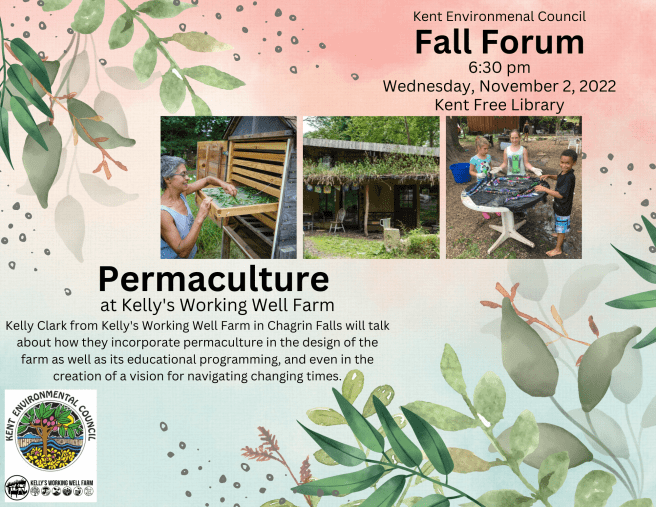
KEC Fall Forum November 2 – Permaculture at Kelly’s Working Well Farm

Kelly Clark from Kelly’s Working Well Farm in Chagrin Falls is the featured speaker at the Kent Environmental Council’s Fall Forum. Clark will talk about how she incorporates permaculture in the design of the farm, the educational programming the farm offers, and her vision for navigating changing times.

Wednesday, November 2, 2022, 6:30pm
Kent Free Library, 2nd Floor meeting room
312 W Main St, Kent, OH 44240

The event is free and open to the public.

For more information about Kelly’s Working Well Farm, click here.

To download the flyer, click here.